AGI Architecture Takes Human-Centred Approach for Collaborative Future
Key Takeaways
Disclaimer
The content on this page is for informational purposes only and does not constitute financial, investment, or legal advice. Cryptocurrency investments carry risk, including the possible loss of principal. Always do your own research and consult a qualified professional before making financial decisions.
A patent has been filed by IQ Consulting, introducing a Human-Centred Artificial General Intelligence (AGI) architecture. The software is looking to integrate human intelligence and superhuman AGI capabilities in a brand new way.
The system is set up to make sure that AGI remains aligned with human values while solving complex problems in the space. Unlike previous AGI architectures, which struggled with scalability and ethical considerations, this human-centred approach is aiming to keep human users at the top of the decision-making process. The technology that underpins the model is designed to maintain accountability.
The Details of the AGI Architecture
The patent features multiple advancements, including using reputational algorithms to enhance the collaboration between human and AI agents. The system also integrates a global approach with Large Language Models (LLMs) that allow AI agents to translate natural language inputs into a universal problem-solving protocol.
The system uses decision tree architectures along with a rewards model to direct AI attention toward critical tasks. On the other side, blockchain technology is at work to create an auditable, transparent record of every step taken by AI and human problem-solvers. This is done to allow for transparency, which helps provide the mechanic to reward users on their solutions.
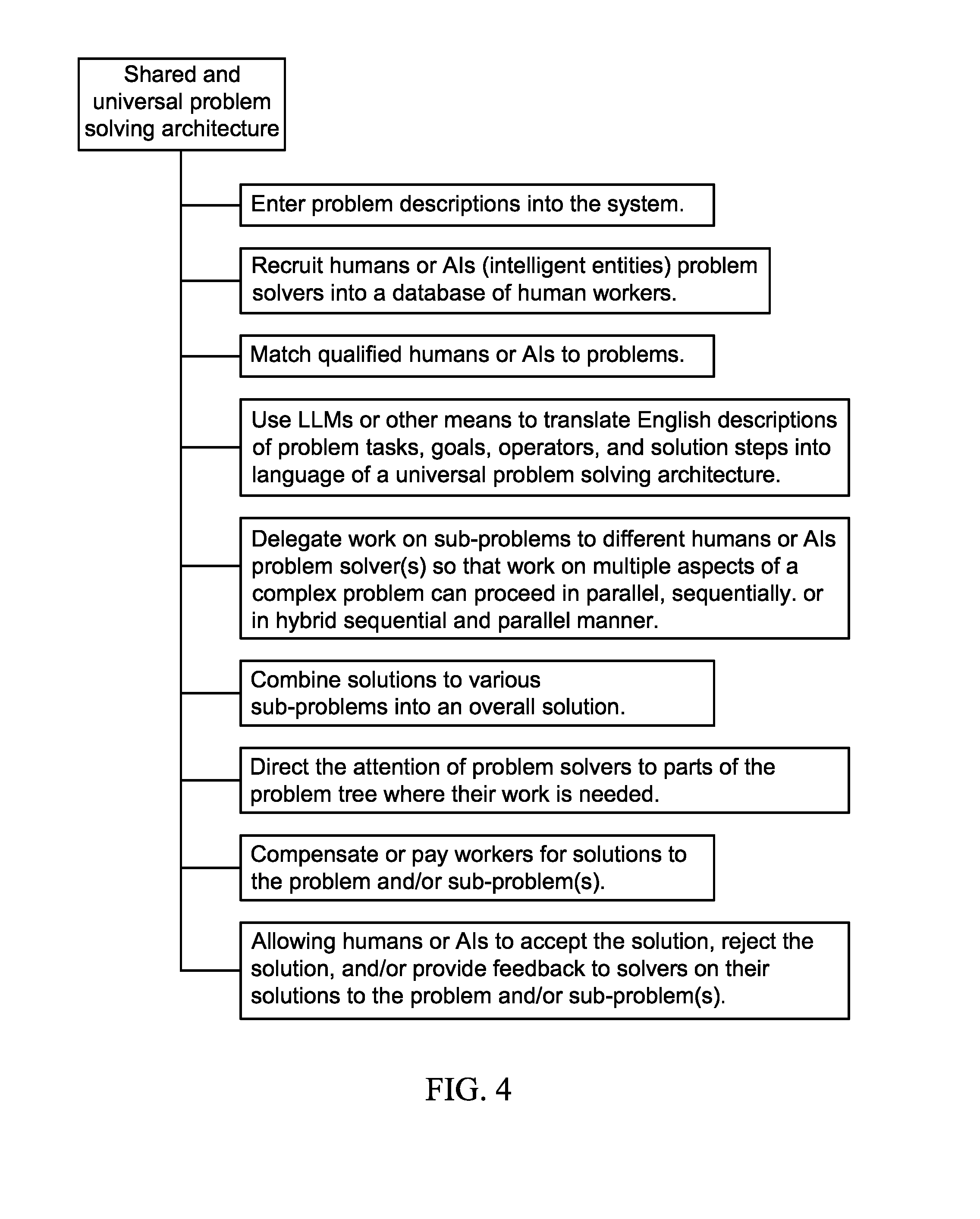
Source: IQ Consulting Company, Patent Application PCT/US2024/017261
How it works:
The method also allows the human users and AI agents to work together over a collective network: When a request is submitted, the AI system uses LLMs to break the problem down into sub-problems, which are then delegated to a network of human workers based on their skillset and expertise.
These human users, in tandem with AI agents, generate sub-solutions, which are then combined by the AI into a final solution. Human users are presented with the solution and have the option to review, accept, or reject with feedback loops that help improve the overall performance of the system.
The model also creates a system of trust and creditability. Reputation attributes and rewards are assigned to human workers based on the quality of their input.
What We Predict This Will Change
Beyond a more transparent approach to an AI model, this system will create a future of AI use where the technology is not just a tool, but a collaborative partner in problem-solving.
Human and AI collaboration can become the norm, where humans work together with the AI agents and each other to solve complex tasks. By allowing the AI to tackle the repetitive or technical tasks, the human users can work on the strategic component in problem-solving. Productivity and creative output can be taken to a new level across sectors.
With AGI systems, industries like healthcare can also experience massive steps forward, with a personalised approach to problem-solving. We could be looking at a world where AI-assisted systems are able to help medical diagnoses with a network of human users agreeing on the diagnosis, which could lead to quicker, more accurate healthcare in complex cases. We could also see it in education where modules are drawn up by a network of humans and combined accurately and efficiency with AI agents. It has the potential to be a big deal where AI is used in a careful and specialised way.
Disclaimer
The content on this page is for informational purposes only and does not constitute financial, investment, or legal advice. Cryptocurrency investments carry risk, including the possible loss of principal. Always do your own research and consult a qualified professional before making financial decisions.